Urgent response throughout Brussels. An emergency? Contact us now at +32 471 70 63 25

en
Cockroaches do not come because it is dirty. They come because there is water, warmth and gaps. Here is what attracts them, where they nest, and why they come back three weeks after a treatment.
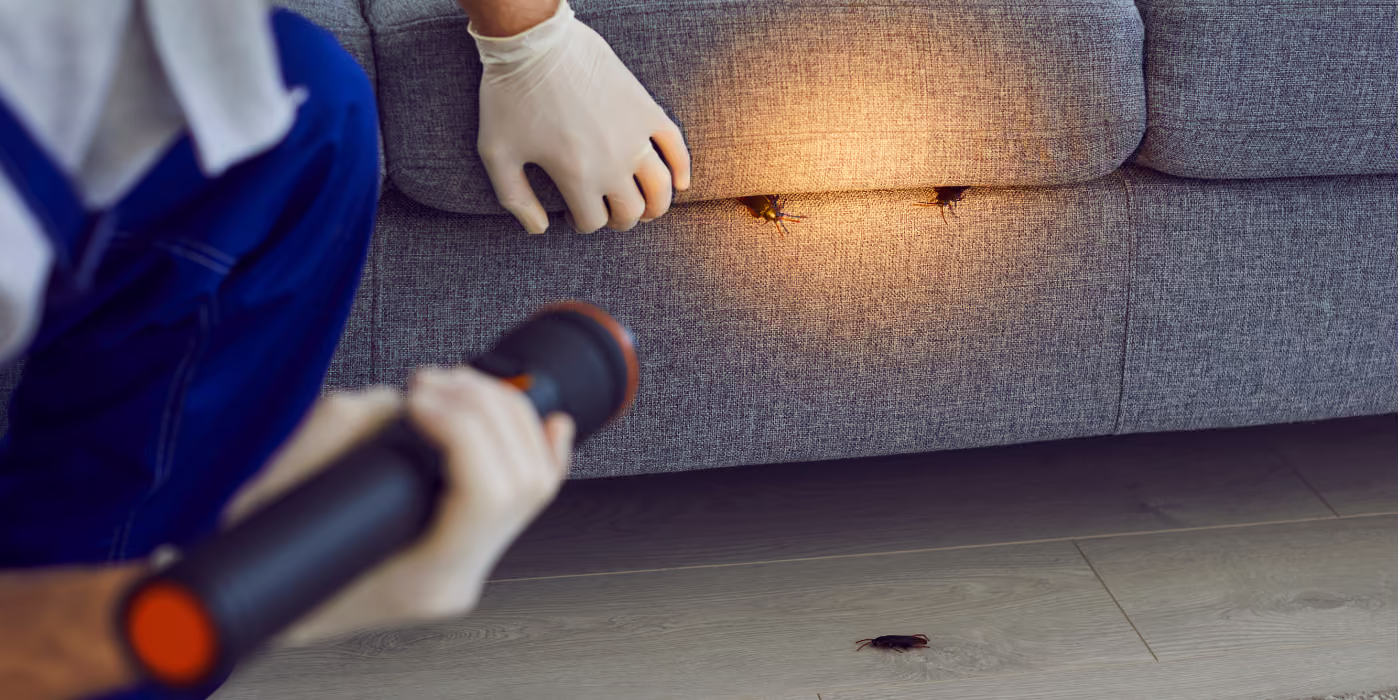
Cockroaches do not come because a home is dirty. They come because they find three things there: water, warmth and gaps to hide in. Food only comes fourth: a crumb is enough. That is why an immaculate kitchen can be infested while the neighbour's is not.
A cockroach survives several weeks without eating, but very few days without drinking. Water is therefore the decisive factor. A leak under the sink, a faulty shower seal, condensation behind the washing machine or a drain that never dries is enough to anchor a population. This is also why bathrooms are as affected as kitchens, even though no one eats there.
A fridge motor, the back of an oven, a dishwasher, a boiler: these areas stay warm permanently. They speed up the development of nymphs and allow a population to breed all year round, regardless of the seasons.
An adult German cockroach fits through a 1.6 mm crack. It looks for spaces where its back and belly touch a surface at the same time: this is a behavioural need, not just a shelter. Cracks in skirting boards, loose joints, electrical boxes, furniture uprights, corrugated cardboard: all are nesting sites.
Food scraps and a badly closed bin, of course. But also the pet's bowl left out overnight, grease built up behind the hob, coffee grounds, the glue of delivery cartons and wallpaper. The diet is very broad, which makes sanitation alone insufficient.
In apartment buildings, the origin is often outside the home. Cockroaches travel through service ducts, refuse chutes and shared pipework. An apartment can be recontaminated indefinitely if the building is not treated as a whole: this is why an individual treatment sometimes fails through no fault of the occupant.
This is the most persistent prejudice, and it wastes time. Cleanliness reduces the resources available and makes an infestation slower to take hold. It does not prevent it. An impeccable home with a leak under the sink and a contaminated building will be infested.
The reverse is also true: sanitation alone does not solve an established infestation. Once the population is settled in the gaps, it breeds on its own reserves.
The cockroach is nocturnal and averse to light: it flees from it. Seeing an individual in daylight signals an already dense population, overflowing from its hiding places. Nests are to be looked for in this order.
Behind and under the fridge, in the motor compartment, under the sink at the trap, in furniture hinges and runners, behind the plinth of the fitted kitchen, inside the dishwasher and the coffee machine. Areas that are both warm and damp are the most likely.
Around pipes that go through the wall, behind the vanity unit, in the pipework passage of the towel radiator, under the shower tray if accessible, in the inspection hatch. The pipe exit through the partition is the most frequent point.
Socket and switch boxes, cracks in skirting boards, behind frames and mirrors, in stored cardboard boxes, under loose linoleum, in service ducts. In an advanced infestation, nests move up towards the bedrooms and false ceilings.
| Species | Appearance | Where | Should you treat? |
|---|---|---|---|
| German cockroach | 10-15 mm, light brown, two dark parallel bands on the pronotum | Heated kitchens and bathrooms, inside homes and professional kitchens | Yes, without waiting. It is the species that infests and breeds the fastest |
| Oriental cockroach | 20-25 mm, very dark brown to black, glossy appearance | Cellars, crawl spaces, pipework, shared areas | Yes, with a treatment of circulation areas and basements |
| Garden cockroach (wood cockroach) | About 10 mm, light brown, often flies | Accidental entry through a window, in summer. Does not breed indoors | No in the vast majority of cases. A single individual in summer is not an infestation |
This distinction changes everything: mistaking a garden cockroach for a German cockroach leads to treating for nothing, and the reverse loses the weeks during which a German cockroach population doubles.
This is the most frequent question after a first failed treatment, and it has two precise answers.
The female German cockroach does not lay loose eggs: she produces a rigid capsule, the ootheca, which contains 30 to 40 eggs (sometimes up to 50) and which she carries until hatching. This capsule is impermeable to contact insecticides. A product that kills the visible adults does not touch the eggs they carry.
Incubation lasts about 17 days, and 14 to 30 days depending on temperature and humidity. Three weeks after a surface treatment, a new generation hatches. A female produces about 5 to 7 oothecae in her lifetime, and the full cycle from egg to adult spans 3 to 6 months.
This is the second factor, and it is massively documented. A study published in the Journal of Economic Entomology (2024) tested consumer residual insecticides on German cockroach populations: pyrethroid-based products killed less than 20% of individuals exposed for 30 minutes to a treated surface. Even on cockroaches confined to the treated surface, most products took 8 to 24 hours to act, and some up to five days.
The cause is genetic and very widespread: more than 96% of German cockroaches screened in one study carried at least one copy of the L993F sodium channel mutation, which confers resistance to pyrethroids. In some populations, resistance to cypermethrin, one of the most common active ingredients in sprays, was measured at about 200 times that of a susceptible population.
On top of this comes a behavioural effect: a resistant cockroach simply leaves the treated surface if it has the choice. The spray disperses it instead of killing it.
Gel baits give very different results. In the same studies, all the gels tested eliminated at least 80% of adult cockroaches within 28 days. Resistance to fipronil, a frequent active ingredient in baits, was measured there at about 14 times that of a susceptible population, against 200 times for cypermethrin.
The principle is different: instead of chance contact with a surface, the bait is ingested, then passed on in the nest through droppings and cannibalism. It reaches the hidden individuals, which a spray never does. See our entry on cockroach gel, and our article on why shop-bought products are not enough.
If you see cockroaches in daylight, if you find droppings in clusters or a persistent smell, the population is already established and a surface treatment will not be enough. Our insect control in Brussels treats the source and not only the visible individuals: free diagnosis, intervention within 24 h, price announced in advance, gel treatment in a single visit if the infestation is moderate, otherwise a pack of several visits, because the eggs already laid hatch after the first visit.
Have any questions? Check out our expert answers to the most frequently asked questions.
For rapid intervention in Brussels, with tailored solutions adapted to your situation.

Pest control specialists in Brussels.