Urgent response throughout Brussels. An emergency? Contact us now at +32 471 70 63 25

en
"Bed flea" does not refer to any real insect. In the vast majority of cases, it is a bed bug. Here is how to tell the three parasites apart, and settle it with three checks.
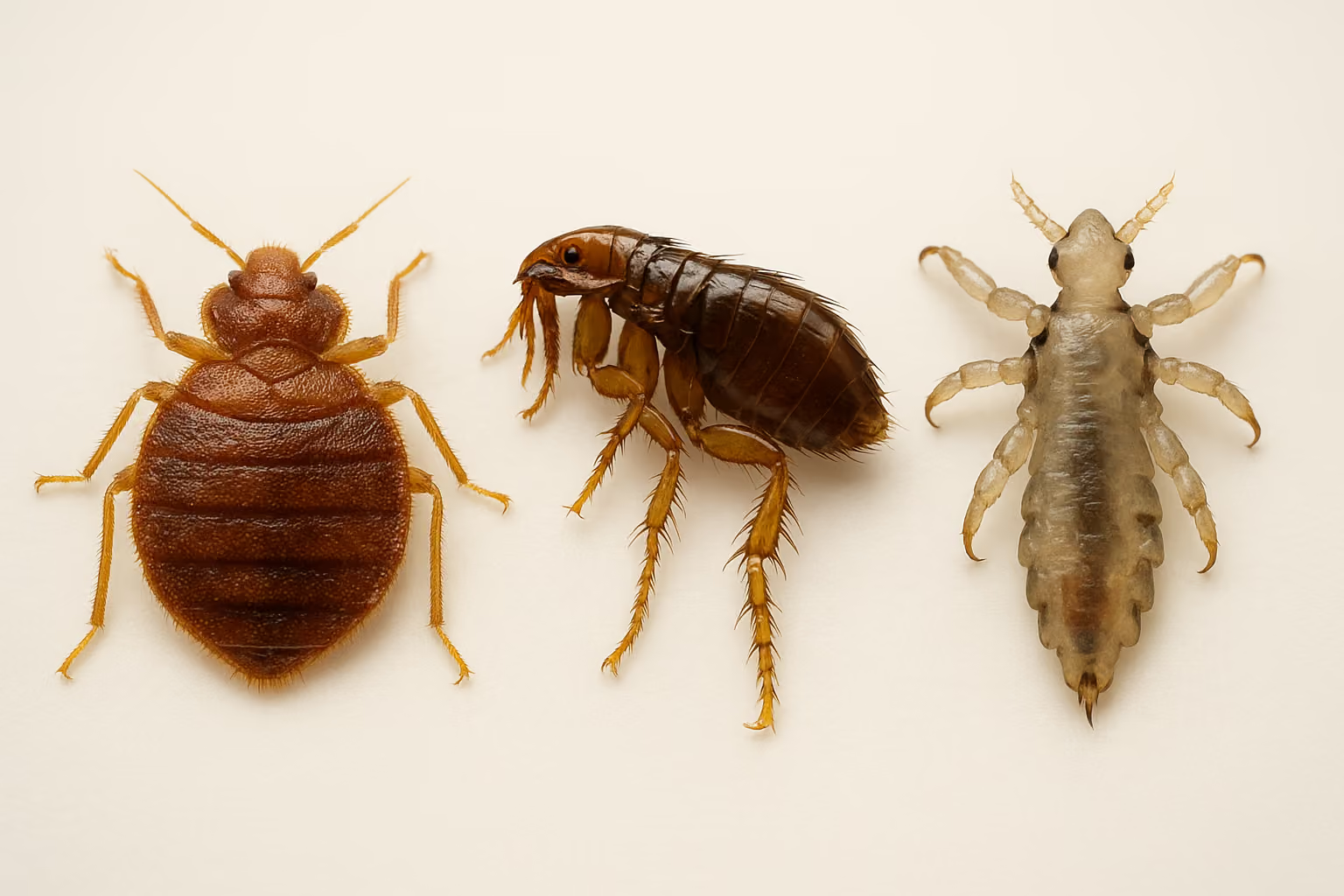
"Bed flea" does not match any real insect. It is a common expression that refers, in the vast majority of cases, to a bed bug. In the other cases, it is a cat or dog flea that has bitten in bed. The two are treated differently, and can be told apart with three checks.
The expression is used by reflex, because we associate "small insect that bites" with "flea". It actually covers three very different situations:
This confusion has a practical consequence: the two parasites are not treated in the same place. Treating the bed when the source is in the carpet and the cat's basket solves nothing.
| Bed bug | Flea | Head louse | |
|---|---|---|---|
| Adult size | 4 to 7 mm: comparable to an apple pip | 1 to 3 mm | 2 to 3 mm |
| Appearance | Oval, flattened on top, reddish-brown. Swollen and redder after a meal | Flattened from the sides, dark brown, shiny, long hind legs | Elongated, grey-white to brown, six hooked legs |
| Movement | Crawls. Does not jump, does not fly | Jumps, very high and very far for its size | Clings to hair, does not jump |
| Where it lives | Cracks within 2 m of the bed: mattress seams, bed base, headboard, skirting boards | Rugs, carpets, parquet, the pet's basket: not in the bed | Exclusively on the human scalp |
| Host | Human | Cat, dog, sometimes rodent. Humans are a fallback host | Humans only |
| What you see | Black spots and blood marks on the sheets, moults, stuck eggs | Small black grains in the pet's coat, an insect that jumps | Nits stuck to the base of the hair, near the nape |
| Where to treat | The bed structure and the whole bedroom | Fabric floors, basket, and the pet | The scalp, at the pharmacy |
In this order, they almost always settle it within a few minutes.
For identifying eggs and moults, our article on how to recognise bed bug eggs details exactly what to look for.
An insect of 4 to 7 mm as an adult, oval and flat, reddish-brown. It lives in the cracks right next to where people sleep and comes out at night to feed, attracted by body heat and exhaled carbon dioxide.
Its cycle includes five nymphal stages, each needing a blood meal before the next moult. The eggs, white and under 1 mm, are stuck in corners and hatch in 5 to 12 days depending on the temperature. It is this shell that explains why a surface treatment fails: it protects the egg from contact insecticides.
It has nothing to do with how clean the home is, and it spreads through luggage, second-hand furniture and shared walls in apartment buildings.
An insect of 1 to 3 mm, flattened from the sides (which lets it move between hairs), dark brown and shiny, with very developed hind legs. It jumps, and that is its signature.
A point that is often misunderstood: the adult visible on the pet represents only a small part of the population. Most of it is made up of eggs, larvae and cocoons spread through the home's fabrics: carpet, rugs, gaps in parquet, basket. This is why treating only the pet is not enough, and why fleas reappear a few weeks later.
The cocoons are particularly resistant and can stay dormant for several months, with hatching triggered by vibrations and carbon dioxide: coming back from holiday, typically. See our flea entry.
An insect of 2 to 3 mm, elongated, grey-white to brown, with six hooked legs that let it cling to hair. It lives exclusively on the human scalp and survives only a very short time away from its host.
It therefore never settles in a bed, a mattress or a sofa. The nits, white eggs stuck to the base of the hair, most often near the nape and behind the ears, confirm the diagnosis. Transmission is by direct head-to-head contact, and treatment is a matter for the pharmacy, not for a pest control company.
Bed bug: do not spray anything and do not change rooms. Bag the fabrics on the spot, wash at 60 °C with high-temperature drying, and have the diagnosis confirmed. A surface treatment does not reach the eggs. Our professional bed bug treatment in Brussels includes a diagnosis within 24 hours, a package of 3 to 6 visits estimated at the diagnosis (on site or by video) and a three-month re-intervention guarantee.
Flea: treat the pet at the vet and the home at the same time. Vacuum fabric floors thoroughly, throw away the bag immediately, wash the basket hot. If the population is established in the fabrics, an insect control intervention in Brussels treats the hidden stages that vacuuming does not remove.
Louse: treatment at the pharmacy and a nit comb. No professional intervention is needed, and washing the bedding at 60 °C is more than enough on the home side.
If doubt remains after these checks, the diagnosis is free and we say so frankly when it is not our field. To tell the bites themselves apart rather than the insects, our article details how to recognise a bed bug bite and tell it from other spots.
Have any questions? Check out our expert answers to the most frequently asked questions.
For rapid intervention in Brussels, with tailored solutions adapted to your situation.

Pest control specialists in Brussels.