Essential oils have a temporary repellent effect on bed bugs, but their effectiveness remains limited to 20% against 98% for professional treatments, requiring expert intervention for complete eradication.
25/06/2025
Introduction
Direct answer: Essential oils have a temporary repellent effect on bed bugs, but are not an effective eradication method. Scientific studies show that you need 70,000 times more essential oil than professional insecticide to obtain the same lethal effect.
Bed bugs have become one of the most dreaded scourges in our homes. Faced with these nocturnal parasites that turn sleep into a nightmare, many people turn to essential oils as a "natural" and "harmless" solution. This trend is explained by growing distrust of chemical treatments and the appeal of remedies presented as "miracles" on forums and social media.
What you need to know :
✅ What essential oils can do:
Slight repellent effect: they may temporarily bother a few bed bugs
Preventive supplement: possible use when travelling
Action on direct contact: a drop of pure oil can kill an isolated bed bug
❌ What they CANNOT do:
Eradicate an infestation: effectiveness of only 15-25% vs 98% for professional treatments
Act on eggs: no effect on the embryonic stages
Guarantee a lasting result: the effect fades quickly
Stop reproduction: bed bugs keep multiplying (up to 500 eggs per female)
⚠️ The little-known risks:
Spreading the infestation: the repellent effect pushes bed bugs into other rooms
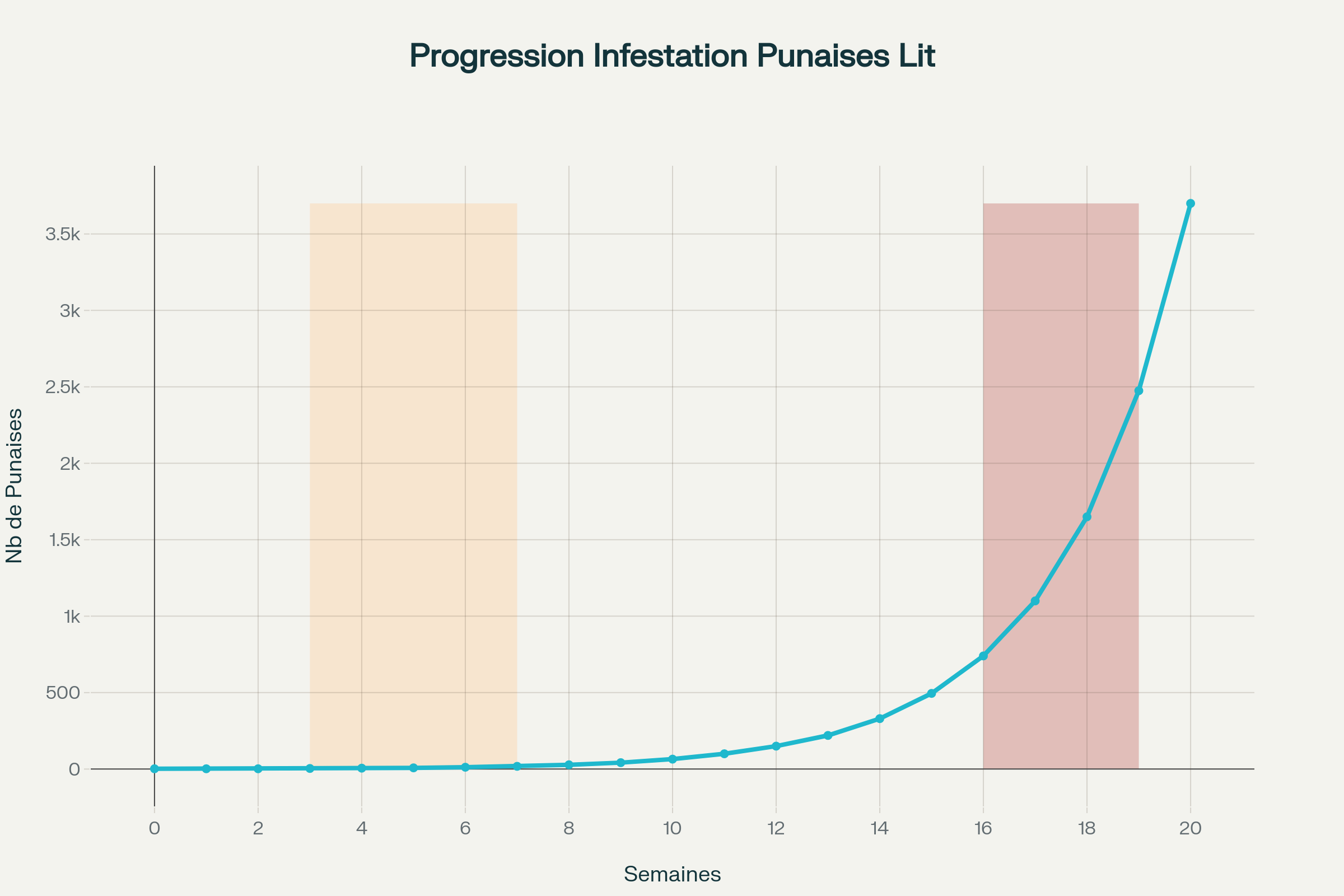
Critical loss of time: while you experiment, the infestation grows exponentially
Higher final cost: 200-400€ of oils + professional treatment = more expensive than a direct intervention
Contraindications: dangerous for pregnant women, children, asthmatics, animals
In this article, we cover:
Why bed bugs resist natural treatments
Which oils have really been tested by science (clove, tea tree, lavender...)
The exact scientific evidence of their (in)effectiveness
The myths to debunk and the hidden risks
The methods that really work (95-98% success) to eradicate bed bugs for good
When and how to act to avoid a massive infestation
The stakes are crucial: every week lost lets bed bugs multiply by the dozens. A quick and effective intervention is the only guarantee of getting peaceful nights back with no risk of recurrence.
Why bed bugs are so hard to eliminate
Bed bugs are not just annoying insects. They are extremely resistant, discreet and quick to reproduce. This is what makes their eradication so complex, especially without professional treatment.
1. Fast and silent reproduction
A single female can lay up to 500 eggs during her life, at a rate of 2 to 5 eggs a day. These eggs are tiny, whitish, and often hidden in cracks or under mattresses. Within a few weeks, a light infestation can become uncontrollable.
2. Invisible by day, active at night
Bed bugs flee from light. They hide during the day in:
Mattress seams
Bed bases
Skirting boards
Wall cracks
Electrical sockets and hollow objects
They come out only at night to feed on human blood, which makes them hard to detect in the first weeks.
3. Resistance to standard insecticides
Over the years, bed bugs have developed resistance to consumer insecticides, particularly those containing pyrethroids. This means that over-the-counter products are often ineffective or only temporarily drive away the insects without eliminating them.
4. Consequences for health and quality of life
Beyond the bites, bed bugs have a significant psychological impact:
Anxiety and chronic stress
Sleep disorders
Social isolation
Physical and mental fatigue
Which essential oils are the most used?
Faced with distrust of chemical insecticides, many people look for more natural alternatives to fight bed bugs. Essential oils are often cited as "miracle" remedies on forums and social media. But they are not all equal, and their effectiveness varies widely.
Here are the essential oils most commonly recommended against bed bugs:
1. Clove (Eugenia caryophyllus)
Active molecule: Eugenol
Action: Natural insecticide, often cited as the most powerful against bed bugs.
Properties: Toxic on contact to some insects, strong repellent effect.
2. Tea Tree (Melaleuca alternifolia)
Active molecules: Terpineol, terpenes
Action: Antiparasitic and antifungal
Properties: Repellent, used in many natural hygiene products
3. Spike or true lavender (Lavandula spica / angustifolia)
Active molecules: Linalool, camphor
Action: Reputed to soothe bites and repel insects
Properties: Mild repellent, often used for prevention
4. Lemon eucalyptus (Eucalyptus citriodora)
Active molecule: Citronellal
Action: Repellent and slightly insecticidal
Properties: Strong smell, effective against many insects (mosquitoes, fleas...)
5. Java citronella (Cymbopogon winterianus)
Active molecules: Citronellal, geraniol
Action: Repellent on insects, notably mosquitoes
Properties: Less targeted at bed bugs, but used in synergy
6. Common oregano (Origanum vulgare)
Active molecule: Carvacrol
Action: Very powerful on the insect nervous system
Properties: Potential insecticide, but can be irritating
7. Peppermint (Mentha piperita)
Active molecules: Menthol, menthone
Action: Strong repellent
Properties: Intense smell, cooling effect, but irritating when applied directly
8. Rose geranium (Pelargonium graveolens)
Active molecules: Geraniol, citronellol
Action: Moderate repellent
Properties: Floral scent, often used in natural sprays
In summary:
Some essential oils have repellent, even insecticidal, potential, but their effectiveness depends heavily on:
The concentration used
The method of application
And above all... the level of infestation
In the next section, we will see what science really says about these oils, beyond popular belief.

What science really says
Contrary to marketing promises and forum testimonials, scientific research tells a very different story about the effectiveness of essential oils against bed bugs.
The reference study: Purdue University (2019-2021)
Dr. Ameya Gondhalekar's team at Purdue University carried out the most in-depth study of 15 essential oil compounds against bed bugs. Their conclusions are unequivocal:
It takes roughly 70,000 times more essential oil compound than synthetic insecticide to obtain the same lethal effect by direct contact.
This figure reveals the huge effectiveness gap between natural solutions and professional treatments.
The molecules that work best according to research
The study identified the most active compounds:
Carvacrol (oregano and thyme) - The most toxic to bed bugs
Thymol (thyme) - Acts on the insect nervous system
Eugenol (clove) - Recognised by the European Union as a biocide
But even these "champion" molecules remain far less effective than professional insecticides.
The entomologists' firm view
Jean-Michel Bérenger, entomologist at the Marseille university hospital institute, sums up the situation perfectly:
"If you pour a drop of essential oil on a bed bug, you will indeed kill it. However, diluted in water and sprayed into the air, or once dry, essential oils do not kill bed bugs."
He adds a crucial point: the repellent effect can make the infestation worse by driving bed bugs into other rooms of the home.
Rutgers University study: the reality of the market
Research published in the journal Insects by Rutgers University analysed commercial products based on essential oils. Result: very few really work against bed bugs.
Only a few oils showed a slight effect:
Blood orange oil
Marigold oil
But their effectiveness remains far from sufficient for complete eradication.
Myth vs reality
Essential oils against bed bugs are surrounded by many popular beliefs. It is time to separate fact from fiction, relying on scientific facts.
❌ MYTH: "Essential oils kill bed bugs"
✅ REALITY: They mainly have a temporary repellent effect. To kill a bed bug, it has to be in direct contact with a pure oil, which is impossible to achieve across a whole infestation.
Why does this myth persist? "Home" tests show that a drop of pure oil on a bed bug does kill it. But this situation does not reflect the reality of an infestation where the bed bugs are hidden in inaccessible corners.
❌ MYTH: "It's natural, so it's harmless"
✅ REALITY: Essential oils have many contraindications:
Pregnant and breastfeeding women: risk of nervous spasms, nausea, miscarriage
Children under 6: fragile nervous system
Asthmatics: risk of breathing attacks
Pets: toxic to cats (eucalyptus in particular)
Direct skin application: risk of irritation, burns, allergic reactions.
❌ MYTH: "It's cheaper than professional treatments"
✅ REALITY: The hidden cost of essential oils can exceed that of a professional treatment:
Cost of essential oils:
15-25€ per quality bottle
Repeated applications needed (several times a week)
Treatment duration: several months
Estimated total cost: 200-400€ over 3 months
Cost of Fix Nuisible professional treatment:
From 450 €: package of 3 to 6 visits estimated at the diagnosis
3-month re-intervention guarantee
Duration depends on the number of visits planned at the diagnosis
❌ MYTH: "It works if you persevere"
✅ REALITY: Persevering with essential oils can make the situation worse:
Lost time: While you experiment, the infestation grows exponentially
Spreading: The repellent effect pushes bed bugs into other rooms
Behavioural resistance: Bed bugs may get used to repellent smells
Que Choisir survey (2021): 75% of people who used only essential oils took more than a month to solve their problem, against a few days with a professional treatment.
❌ MYTH: "Oil synergies are more effective"
✅ REALITY: Combining several oils may improve the repellent effect, but does not fundamentally change the effectiveness. A synergy of repellents is still... a repellent.
What is more, multiplying the oils increases the risk of allergies and contraindications.
❌ MYTH: "It's recommended by experts"
✅ REALITY: No recognised entomologist recommends essential oils as a main treatment against bed bugs. They may be mentioned as a preventive supplement, but never as a cure.
What experts really recommend:
Professional heat treatment
Specialised insecticides applied by professionals
Mechanical methods (steam, washing at 60°C, freezing)
Comparison with effective treatments
Now that we have taken stock of the limits of essential oils, let us see which methods really work against bed bugs. The difference in effectiveness is striking.
Heat treatments: the absolute reference
Principle: Raise the temperature of the premises to more than 50°C for several hours, or use dry steam at 180°C on infested surfaces.
Why it is effective:
100% natural: no chemicals
Acts on all stages: eggs, larvae, adults
No resistance possible: bed bugs cannot adapt to heat
Deep penetration: the heat reaches the most inaccessible hiding places
Success rate:95-98% in a single intervention
Duration:1 to 2 days for a complete treatment
Professional insecticides: expertise and rigorous protocols
Unlike consumer products, professional insecticides are:
More powerful:
Active molecules at high concentration
Specific anti-resistance formulations
Residual action (long-lasting effect)
Better applied:
Targeted spraying in the right areas
Precise dosage according to the level of infestation
Fumigation technique to reach all hiding places
Success rate:85-95% with a full protocol
The Fix Nuisible multi-method approach
At Fix Nuisible, we do not settle for a single technique. Our 5-step method combines:
Complete diagnosis: careful inspection to locate all infested areas
Steam treatment at 180°C: immediate elimination of all development stages
Spraying of long-residual insecticides: long-lasting protection
Installation of monitoring traps: detection of residual activity
Fumigation of the rooms: treatment of hard-to-reach areas
Package of 3 to 6 visits: estimated at the diagnosis, on site or by video
Guarantee:free re-intervention for 3 months, on receipt of a video
Why are professional methods so effective?
1. Technical expertise:
Knowledge of bed bug behaviour
Precise identification of breeding areas
Choice of the method suited to the level of infestation
2. Professional equipment:
High-temperature steam cleaners
Pressure-controlled sprayers
Products not available to the general public
3. Proven protocols:
Methodical preparation of the home
Application to strict standards
Rigorous monitoring of results
4. Re-intervention guarantee:
Free re-intervention for 3 months
Triggered by simply sending a video
Support until the end of the treatment
Conclusion: the reality behind the myth
After going through the scientific studies and testing the promises against the facts, the verdict is clear: essential oils against bed bugs are largely a myth.
With our proven 5-step method and our 98-100% success rate, we aim for complete and lasting eradication.
Intervention within 24 hours anywhere in Brussels
Free diagnosis with no obligation
Transparent prices from 450 €
3-month re-intervention guarantee, on receipt of a video
Absolute discretion to protect your privacy
We do not stop until you have your peaceful nights back.
Bed bugs are a scourge, but they are not inevitable. With the right methods and professional expertise, you can quickly get back a healthy environment and restful sleep.
Do not let bed bugs ruin your life any longer. Definitive eradication starts with a simple phone call.
FAQ
FAQs
Have any questions? Check out our expert answers to the most frequently asked questions.
Can essential oils really kill bed bugs?
Partially, but not effectively. A drop of pure essential oil applied directly to a bed bug can indeed kill it. However, once diluted in water (as recommended for home use), their effectiveness drops drastically. Studies from Purdue University show that it takes 70,000 times more essential oil compound than professional insecticide to obtain the same lethal effect. In practice, essential oils mainly have a temporary repellent effect that can even make the infestation worse by driving bed bugs into other rooms.
Which essential oil is the most effective against bed bugs?
Clove essential oil is considered the most effective thanks to its richness in eugenol (80-85%), a molecule recognised by the European Union as a biocide component. Tea tree, oregano (rich in carvacrol) and thyme (containing thymol) also show some insecticidal activity in the laboratory. However, even these "champion" oils remain largely insufficient to eradicate a real infestation. Their overall effectiveness does not exceed 20-25%, against 98% for professional multi-method treatments.
Are essential oils safe for treating bed bugs?
No, contrary to popular belief, essential oils present many risks. They are strictly contraindicated for pregnant and breastfeeding women (risk of nervous spasms, miscarriage), children under 6, and asthmatic or epileptic people. They can cause severe skin irritation and allergic reactions and are toxic to some pets, notably cats with eucalyptus. In addition, intensive use can cause headaches, nausea and breathing problems. It is essential to always dilute them and ventilate well after application.
In which cases can you try essential oils against bed bugs?
Essential oils are only conceivable in very limited situations: infestation discovered within 48 hours with fewer than 5 bed bugs seen, a single room affected, no contraindication in the household (no pregnant women, children, asthmatics, sensitive animals). Even in these optimal conditions, you must stop immediately if no improvement is visible after 7 days or if the infestation seems to be spreading. In all other cases, contact a professional directly because every day of delay lets bed bugs multiply exponentially and complicates the final eradication.
Can essential oils drive bed bugs into another room?
That is the main risk: a repellent smell does not kill, it displaces. The bugs move further away, into skirting boards or a neighbour's flat, and the infestation becomes harder to locate.
What if I have already used essential oils?
Tell the technician before the visit. Oily residue can affect how the products adhere, and the bugs have probably moved: the assessment takes that into account. Nothing is irreversible.